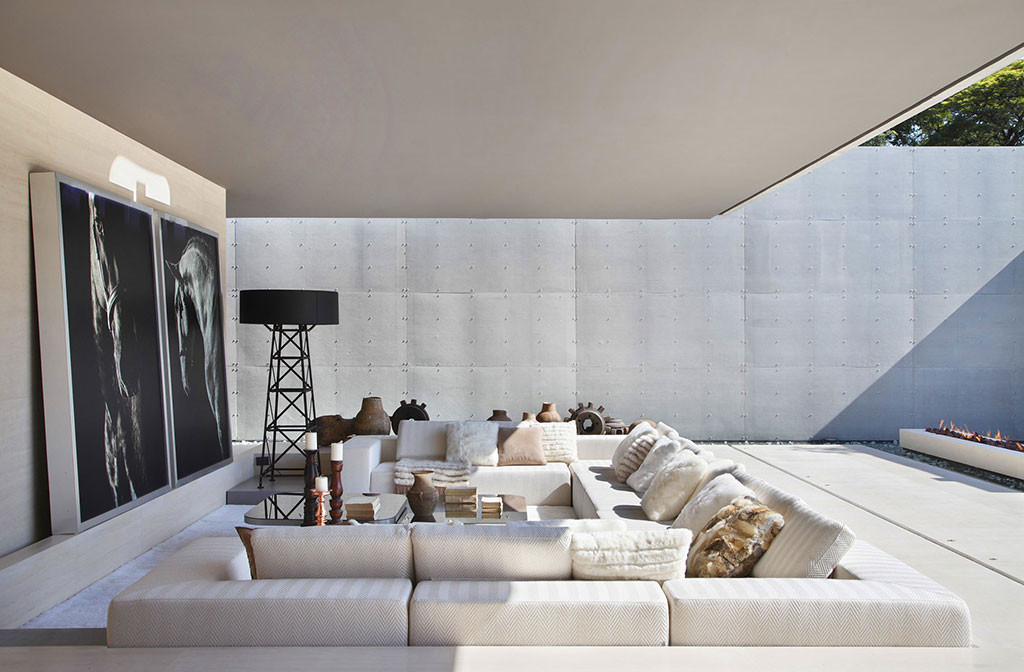
Mastering the Art of Dissolving the Indoor-Outdoor Divide

In the history of residential architecture, the wall has traditionally served as a fortress—a rigid boundary designed to keep the elements out and the inhabitants safely tucked away. However, as our understanding of wellness and environmental psychology has evolved, so too has our approach to the perimeter of the home. Modern design is no longer about separation; it is about integration. The concept of dissolving the indoor-outdoor divide has become the gold standard for contemporary luxury and mindful living, transforming the home from a closed box into a breathable pavilion that exists in harmony with its surroundings.


The Philosophy of Biophilic Connectivity

At the heart of the movement to erase the boundaries of the home is biophilic design. This philosophy suggests that humans possess an innate tendency to seek connections with nature and other forms of life. When we dissolve the divide between our living rooms and our gardens, … Read more

Material Innovation: Beyond Standard Glass in Modern Architecture

For centuries, glass has been the primary medium through which we connect our sheltered indoor lives with the world outside. From the hand-blown panes of the Renaissance to the massive plate glass windows of the mid-century modern era, the evolution of glass has tracked the progress of human engineering. However, we have entered a new epoch. In the face of climate change, the need for heightened privacy, and the push for “smart” infrastructure, standard silica glass is no longer enough. Today, material science is pushing the boundaries of what transparent surfaces can do, turning static windows into dynamic, high-performance skins for our homes and offices.


The Rise of Smart and Switchable Glass

The most significant leap in material innovation is the transition from passive to active glass. Traditional glass is static; it lets in the same amount of light and heat regardless of whether it is a freezing winter morning … Read more

Mastering The Mirror Effect and Architectural Transparency

In the realm of high-end interior design, the most valuable luxury isn’t gold or marble—it is space and light. As urban living environments become increasingly compact, designers have had to look beyond physical square footage and turn toward the psychology of perception. This is where the dual concepts of the “Mirror Effect” and “Architectural Transparency” come into play. These are not merely decorative choices; they are sophisticated architectural tools used to manipulate reality, dissolve boundaries, and create a sense of infinite openness within a confined shell.


The Mirror Effect: Doubling the Dimension

The mirror is perhaps the oldest “magic trick” in the designer’s handbook. However, using mirrors effectively requires an understanding of physics and visual weight. When placed strategically, a mirror does more than just show a reflection; it tricks the human brain into believing there is a continuation of the room.

To maximize the Mirror Effect, one must … Read more

Mastering Architecture and Space Perception in Interior Design

When we walk into a room, our brains perform thousands of instantaneous calculations. We subconsciously measure the height of the ceiling, the distance between walls, and the way the light hits a corner. This psychological experience is known as space perception. In the world of professional interior design, the goal is often to manipulate these perceptions—making a cramped room feel expansive, a cold hall feel intimate, or a low ceiling feel like it reaches the sky. Enhancing architecture is not always about moving physical walls; it is about using visual cues to redefine the boundaries of a space.


The Psychology of Verticality: Lifting the Ceiling

One of the most common architectural challenges is the “closed-in” feeling caused by low ceilings. To counteract this, designers use verticality to draw the eye upward, creating a psychological sense of height. This is achieved through the principle of continuity.

When you install floor-to-ceiling … Read more

Lighting: The Unsung Hero of Interior Design

When we step into a room that feels “just right,” we often credit the plush velvet sofa, the expensive hardwood floors, or the curated gallery wall. However, there is a silent director behind the scenes controlling how we perceive every one of those elements: lighting. In the world of interior design, lighting is frequently the last thing considered and the first thing budgeted out, yet it is the single most important factor in determining the mood, functionality, and aesthetic success of a space. It is truly the unsung hero that can transform a cold, cavernous room into a cozy sanctuary or a dull office into a high-energy creative hub.


The Three Pillars of Layered Lighting

Professional designers never rely on a single light source. Instead, they use a technique called “layering” to create depth and versatility. To understand how to light a home effectively, one must master the three … Read more